Showing posts with label St. Louis Post-Dispatch. Show all posts

Friday, May 27, 2016

Memorial Day : Remembering Those Who Served So That We Are Free Americans

Fallen Acorns takes on a new meaning for this blog today.  Normally I post about someone who has a tragedy in their life, or some sort of death has occurred that is of  unusual circumstances.

Memorial Day started as a time when this nation of ours remembered their family members, neighbors and friends who gave selflessly to serve our country at a time of war.  Those that lost their lives while serving in the military are special.  They left their homes and never returned.  Those that came back home had scars....some are seen, and many are not seen.  Scars can lurk in  the minds of those who returned with unspeakable horror etched in their memories. The Veteran's Administration was established to help those who returned home, and the families of those who did not.  The remains of the deceased were buried overseas, and many were shipped home to the families a few years after the war, so that they could be laid to rest on American soil.

Today, I wanted to focus on how our nation kept it's citizens informed of these special soldiers and their status during World War II.  I searched The St. Louis Post-Dispatch issues dated during the 1940s to experience how the journalists wrote about the lives of the soldiers that had homes in and around the city.  Searching Newspapers.com, it was not hard to find page after page of stories and articles that must had kept the news writers busy, days on end.

5 December 1944, St. Louis Post Dispatch, page 6, www.newspapers.com, accessed 27 May 2016
Can you imagine opening your newspaper to view photographs of young soldiers from your neighborhood with their status noted under their names:  Dead, Missing, Prisoner, Wounded....

This is what our nation went through during World War II.  Photos of fresh young faces with their unfortunate status printed below them.  It must have been very depressing for everyone.  That war had affected almost every household.  Everyone knew someone who was serving this nation of ours during a time when we did not have these weapons that could be implemented with remote controls and precision targeting.  This was a war the no one wanted to see repeated.

This Memorial Day weekend, take some time away from the backyard grill.  Visit a church service, a veteran cemetery, anything that makes one remember exactly why we celebrate our heroes.  Look at the faces of these soldiers and say a prayer that their suffering was not in vain, and their courage was exceptional in the eyes of the terror of their time.  We have much to be thankful for.  Let's start with a thanks to these guys.

AncestorStuff.com is offering a special FREE SHIPPING event to anyone who would like to read about our military and the wars of our nation.  Buy 3 items from the MILITARY catalog section at www.AncestorStuff.com, and they will be shipped free. Offer expires 13 June 2016.

Friday, May 13, 2016

The Black Hand Gets It's Man

www.newspapers.com, image from St. Louis Post Dispatch, 28 February 1908


16 August 1906.....well-off grocer, Damiano Capuano, receives the first of several letters....

"We know you.   We know what money you have.  And you know us.", the note began.  It went on to give directions to place $1000 in a basket and leave it behind a garden fence in an area known as Baden, in the city of St. Louis.  It ended with a warning, if these instructions were not followed, Capuano would be killed. The message was ignored.

20 August 1906...another note is delivered. It contained the same demand. But, this time the note was marked with a red cross, and the sign of the Black Hand (a zig zag mark) with a skull and crossbones.  Again, Capuano ignored the demand.

During the following week, several similar notes were sent, each one becoming more threatening.  Capuano started to become uneasy. He did not contact the police....until a message on the final note read "Capuano will be marked for the knife".  That got his attention.

He reported the incidents to the Carr Street police station, and Sgt. Adreveno was assigned to the case by Captain Johnson. Federal authorities took possession of the threatening notes.

Words overheard late at night by patrolman Tomasso lead to the arrest of five men.  He was tipped off by an anonymous neighbor, who noticed that a group of men were meeting in the back room of a nearby building.  Tomasso listened as the men spoke Italian, and heard a conversation that most certainly had to do with the notes left for Capuano in the previous weeks. They also made several denouncing comments about the government in America.

After their arrest, it was determined that these men were imitators of the Black Hand Society.  All were questioned....in Italian....because they claimed that they did not know how to speak English.  Handwriting samples were taken of each man, and it was certain that at least one of them closely resembled the writing on most of the notes left for Capuano.

The front page of the St. Louis Post-Dispatch reported on the initial findings of the police department. It had not been determined that any of these men actually wrote the notes.

In the following few years, many others had received similar notes, referring to the Black Hand, and demanding amounts of money from $500 to $1000 each.  This kept the new "Black Hand Squad" in the St. Louis police department very busy.

Unfortunately, late on the evening of 24 December 1910, Damiano Capuano was shot and killed by three bullets as he was walking home.  He had just finished visiting the homes of several colleagues.  Shots rang out in the night and police were summoned into the dark streets of the city.  Capuano was found deceased, bleeding from his wounds.  The Black Hand finally got their man.


Friday, April 8, 2016

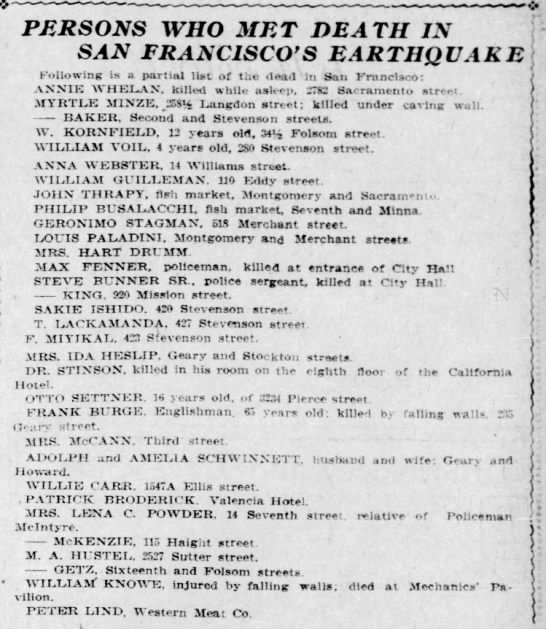
1906 San Francisco Earthquake Victims : Were you related to anyone who lost their life?

In Memory of :

Filippo Busalacchi

Birth: May 5, 1874
Sant' Elia
Provincia di Palermo
Sicilia, Italy
Death: Apr. 18, 1906
San Francisco
San Francisco County
California, USA

He died in the famous 1906 earthquake in San Francisco, CA

Italian Cemetery
Colma
San Mateo County
California, USA
Plot: 22; Grave 25

Maintained by: Spence Burton
Originally Created by: Retaggio
Record added: Nov 15, 2009
Find A Grave Memorial# 44350784

information from www.findagrave.com


I browse newspapers quite frequently for items of interest....Fallen Acorns, to be exact.

San Francisco suffered through a horrible earthquake in April of 1906.  Newspapers across the nation tried to cover the story the best that they could, with what little technology they had at that time.

Lucky for us, we have OCR to use as a valuable tool when hunting for surnames in digital content.

Newspapers.com, a partner of Ancestry.com, has recently increased their content to include a very large selection of American newspapers.  If you haven't used this website, or you haven't looked at it for a while, I highly suggest that you take a few minutes to see what has been added.

I looked into the selections for St. Louis, Missouri, (St. Louis Post-Dispatch) and the Sicilian surname of my mother's family, Busalacchi.  What I found for this date is fantastic.

Are you related to anyone on the list?

19 Apr 1906, Page 3

sreif1956 Member Photo
Member photo for sreif1956

Friday, March 11, 2016

The Dead Can't Testify : Nightclub Owner Goes Free

In the St. Louis Municipal Courts Building, a scuffle broke out in the crowded hallway.  Tony Sansone, Jr. and two others were arrested under general peace disturbance charges.

Mr. Sansone, a Deputy Constable and owner of the La Vida nightclub, located at 521 Washington Avenue, carried a pistol into the court building....I guess there were no metal detectors at the courthouse doors in January of 1935.  Sansone was at the court building to answer to illegal liquor sales charges.   Sansone had failed to obtain the proper licenses for selling liquor. He stated that as he stood at the Police Court entrance, two men known as James Capasso and Tony Busalacki, approached him and began to beat him.  They had unfinished business from a quarrel that they had the evening before.

In an effort to defend himself, Sansone withdrew his pistol from under his coat and hit Busalacki over the head with it.  The crowded corridor was soon emptied as the persons there began to swarm to the doors in order to get out of the way of swinging fists. Sansone was treated for bruises at the nearby hospital, while Busalacki suffered a laceration on his scalp.

The case of Tony Sansone had two continuances, before both parties were fined $200, and appealed.  The court case was carried on the docket eight times before sustaining the fine. On June 27, 1935, a new trial was granted.

Fast forward to August 1935, on the fifteenth court setting for this case, the general peace disturbance charges against Sansone are dropped.  Tony Busalacki, the witness expected to testify again Sansone was no longer alive.  How fortunate for Sansone.  In July, Busalacki was killed in the neighboring county of St. Charles. He had been shot by a member of his own extortion gang....by accident.  OOPS!

 St. Louis Post-Dispatch, 13 Jul 1935, Sat, Main Edition, www.newspapers.com


Busalacki and his extortion chumps were trying to collect a large amount of money from a fellow who had a farm in St. Charles County, just across the river from St. Louis.  While running away from the sheriff, one of the gang mistook Busalacki for a county deputy, and he was shot dead.

http://www.sos.mo.gov/images/archives/deathcerts


Judge Schmitt realized that the chief witness against Tony Sansone, Jr. was Tony Busalacki.  The prosecutors could not make a case against Sansone without the testimony of the dead man. Sansone was released from the court as a free man, thankful for the death of his adversary.

Friday, February 26, 2016

Carnarvon's Crazy Cousin

In mid November of 1924, Mrs. Rosemary Sparkman attended the Ladies Literary Club silver tea event.  The Salt Lake City group presented a musical program amidst the lovely patriotic decorations, which included tables set with white chrysanthemums, red and blue candies, ices adorned with flags and patriotic colored cakes and other sweets.  Mrs. Sparkman appeared with Miss Ethelyn Cannon to present "The Cake Walk" during the program.  Everything seemed wonderful.

Channel forward in time....about 30 days....mid December of 1924.  On a Saturday evening, a young mother, Rosemary Sparkman, age 28, falls into a deep case of depression.  Somehow, things seemed hopeless for her on this very day, even though she had been seen by a physician for her repeated melancholy for quite some time.

This young mother decided that this very day would be the last for her and her two children on this earth.  With careful tending, Rosemary had her children dressed in their night clothes and tucked into bed.  After they had dozed off, she took a soft cotton cloth, dipped in chloroform, and placed it over their nose and mouth.  She took a rubber head cap and put it over their faces to keep the effects of the chloroform from escaping into the bedroom.  Both children were introduced to eternal sleep by their mother.

Mrs. Sparkman undressed herself for the evening and, leaving on her stockings and a long cotton gown, lay down on the floor of the parlor.  She had turned on four gas burners of the heating stove.  This was the last of her life.  She had decided to do to herself that which she had done to her children.

Photo found on Googlesearch.com , note the mistake on the name of the university that employed her husband.


The St. Louis Post-Dispatch issue of 8 December 1924, reported that Mrs. Sparkman and her children were found lifeless.  Her husband was out of town on business.  Mr. Colley Sparkman was an assistant professor of languages at the University of Utah.  The bodies were found by George Ross, owner of the home in which the Sparkman family lived.  He detected the smell of gas as he entered the back door of the home.  Finding Mrs. Sparkman on the floor, he summoned the police.  Detectives arrived just minutes after the gas valves had been turned off.

The children were found in their beds, both having burns on their lips and faces, apparently from the chloroform.  Mrs. Sparkman also had burns on her lips from dosing herself with the same cloth saturated with the drug.

A note was found in the vestment worn by Rosemary.  It read : "lay me away quietly.  No friends, I had no friends in life, nor was I granted them in death.  Let me be alone."

In a brief interview with Mr. Sparkman, he told his life with his wife and children.  He was so proud of his dear Wilford, age 9, and Lorna, age 7.  He did worry about his wife's occasional despondency, but felt she was fine to leave with the children while on a business trip.

Upon further inquiry regarding the family of Rosemary, it was revealed that she was the daughter of Robert Carnarvon and Cecilia McIntyre, born in Scotland in 1896.  Mr. Sparkman  added that Rosemary was the cousin of the late Lord Carnarvon of England.  You might remember him as the financier and discoverer of  the tomb of King Tutankhamen, in Egypt, with his partner, Howard Carter. Lord Carnarvon died in 1923 as a result of shaving an infected mosquito bite, which progressed to acute pneumonia.  Some think it was attributed to the Curse of the Tomb.  Could the curse have affected other family members?  Like Rosemary Carnarvon Sparkman?  I will leave that research up to you...if you dare!

The grave memorial #166413 for Rosemary can be found at www.findagrave.com in Mount Olivet Cemetery, Salt Lake City, Utah.

A detailed newspaper report can be found in the Ogden Standard -Examiner, 8 December 1924, page one.